
Snow with two droste steps
- More freedom
- How to
- Double worker pairs
- Spidery/Snowy/Asymmetrical connections
- 3/6 pair recipes
- 4/8 pair recipes
More freedom
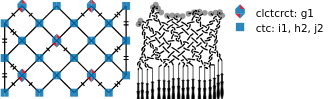
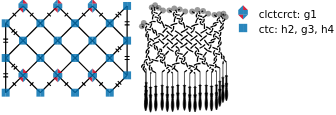
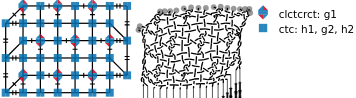
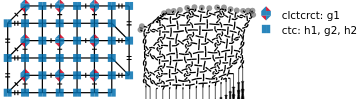
With two droste steps you have way more options to combine snowflakes than with the snow mixer. The mixer combines four snowflakes like the first configuration shown below. With two droste steps you can assign a recipe to any stitch in any pattern, so even way more than the four configurations below. The price for the freedom: more steps to apply a predefined recipe, that takes only two clicks with the mixer.
How to
 You can select any pattern from any gallery and use plaits with three threads as stitches,
for example lclc or rcrcrc between other stitches (or not).
This looks like highlighted in the image on the right.
You can select any pattern from any gallery and use plaits with three threads as stitches,
for example lclc or rcrcrc between other stitches (or not).
This looks like highlighted in the image on the right.
Let us take a mixer recipe from the table as an example.
 which is: lclc; tc,rclcrc,clcrcl,ct and flipped: rcrc; tc,lcrclc,crclcr,ct
Apply the lclc and/or rcrc stitches on the stitches page.
You can apply the rest of the recipe after following the link to thread diagram as pair diagram.
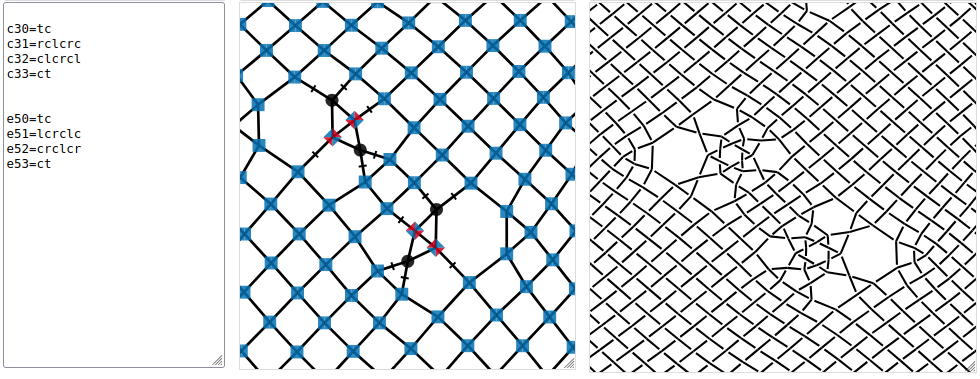
Compare the text box and thread diagram of the screenshot with the recipes. You don’t need to edit the big text box, but in this case it can be easier to copy-paste the recipe and edit to get something like the screenshot. The start of the ID-s like c3 and e5 depend on your pattern and where you applied the plait stitches. The number of lines depend on the number of stitches in your snowflake recipe. After applying the broomstick, the lines will get reorganized and the recipe no longer recognizable.
Even when changing stitches by clicking the thread diagram, you need the wand to re-render the diagrams because this page can be very slow. Outdated diagram parts are highlighted grey and black until rerendering.
Note that for the second step, you need to re-render the pair diagram before re-rendering the thread diagram. Otherwise, the changes don’t appear.
Double worker pairs
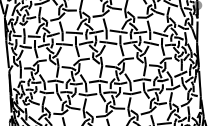
Two of the example configurations above haver worker pairs in the initial pair diagram These pairs become two workers going together from left to right, negotiate a footside and return together through the next row of snowflakes.
Spidery/Snowy/Asym connections
Traditionally, spiders start with two groups of pairs, and they have two groups of leaving pairs. Traditional six pair snowflakes have three groups of starting/leaving pairs. With the droste method we get asymmetrical connections for 3/6 pair connections.

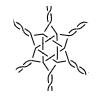
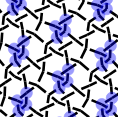
Note that with 4/8 pairs we can’t divide the pairs into three groups, so this is not enough tell spiders from snow.
3/6 pair recipes
The table below shows the snow mixer recipes in a format suited for two droste steps explained above. From an overview on the counting snow page, we learn that this gallery covers very little of the possible six pair connections, see tweak recipces for more variations.
Under construction
With two droste steps, we should not need a leading dash
for an odd number of stitches to make it an even number.
The dash (meaning: skip a stitch) is an accidental feature
and can cause problems outside the mixer.
| 3-pair thread diagram | recipe of the diagram | flipped recipe |
|---|---|---|
 |
rcrcrc crc,crclctc,ctcrc,rcl,c,c |
|
 |
lclclc rcl,ctc,crcllc,crrclcr,ctc,cl |
|
 |
rcrcrc -,ctc,ctc,ctc,ctc,ctc |
|
 |
lclc tctc,rctcl,ctcl,ctct |
|
|
lclc tc,rclcrc,clcrcl,ct |
rcrc tc,lcrclc,crclcr,ct |
 |
rcrc tcr,lctc,ctcr,lct |
|
 |
rcrc tcl,lctc,ctcr,rct |
|
 |
rcrc t,lctc,ctcr,ctct |
|
 |
lclclc -,c,ctctc,ctctc,ctctc,c |
|
 |
lclclc t,rc,ctc,rclcr,ctcl,ct |
|
 |
lclc t,rctc,ctctcl,ctct |
|
 |
rcrcrc -,cr,crcl,clcrclcr,rcrcl,c |
|
 |
lclclc cr,crcl,clcr,crcl,clcr,c |
|
 |
rcrcrc -,cr,crcl,clcr,crcl,cl |
|
 |
lclclc -,cl,ctcl,crcrcr,rcr,c |
|
 |
lclclclc -,lc,crc,clcrc,clcr,c,crc,cl |
|
 |
rcrcrc -,cr,ctcr,clclc,lcl,c |
|
 |
rcrcrc ctct,ct,ct,ct,cl,ctc |
|
 |
rcrc lc,crclclc,crcrclc,cr |
|
 |
rcrcrc cr,ctcl,ctcr,ctcl,ctc,c |
|
 |
rcrc r,lrc,ctcr,lct |
|
 |
rcrcrcrc c,ctc,rclc,ctc,rc,rcl,ctc,c |
|
 |
lclc rc,clcrc,clctc,rcl |
|
 |
rcrc lcrc,clcrc,clcrc,clcr |
|
 |
rcrcrc -,c,ctctc,clcr,rctc,c |
|
 |
lclclclc r,c,crc,ctc,lcrcl,ctc,crc,cl |
|
 |
lclclc -,ctc,ct,crc,ctc,ctc |
|
 |
rcrcrc -,cl,ctctcr,ct,ctc,c |
4/8 pair recipes
It is impossible to be exhaustive, the table below is just a start. See also MAE-gf.
| initial stitch |
first droste step note about ID’s (g1) |
second droste step |
|---|---|---|
| ctcctct | g13=ctcctc g18=g19=tt |
g133=ctcctc g180=g181=g190=g191=tt |
 |
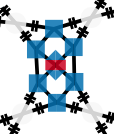 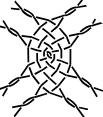 note about the legs |
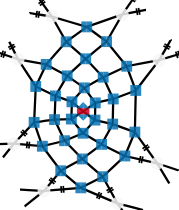 |
| rctcr | g10=cl g11=llclcr g12=llclcrclcll g13=crclcrcl g14=clcrll g15=c other note about legs |
g100=g150=c g110=g120=g128=g144=tt 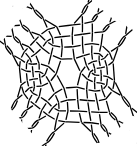 |
| clctcrct | g10=g17=c g11=rclcr g12=crc g13=rctc g14=ctcl g15=clcr g16=crcl g18=g19=tt |
g100=g170=c g180=g181=g190=g191=tt 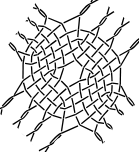 |
| ctct | g11=g12=ctctc g14=g15=tt |
 |
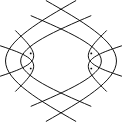
| ctct | g11=ctcrctc g12=ctclctc g14=g15=tt |
 |
Stitch ID’s
The columns first/second droste step assume that the initial stitch is applied to the stitch with ID g1.

As you can apply the recipes to any stitch in any pattern,
you will have to replace the g1 ID prefixes with the proper value.
See also how to for more details, in that explanation the initial stitches are plaits of three threads.
Crossed legs in both steps
The first example is a traditional spider. Note that leading/trailing twists in the initial stitch cause crossed legs in the pair diagram of the first droste step. Assigning just twists to these stitches nicely separates the legs into twisted pairs. Due to the nature of the droste effect, that effect repeats in the second droste step.
Crossed legs in second step only
The initial stitch in the second example uses all twists for the “bolletje”. So we can’t use the crossed legs trick in the first droste step, we have to add the legs to other stitches. The four ll’s in three stitches of the first droste step become the twisted legs in the second droste step.
More notes
Repeated actions (repeated twists or repeated crosses) become a single stitch when a thread diagram is used as pair diagram.
The blob analysis (to capture new spiders/bollletjes) needs slightly different rules. The blobs are not only left or right, we also have blobs in the center.
Patterns like wobble can be created with a single droste step. Use alternating initial stitches, combine for example c with tctct for plain rose ground units, or with tclcrct or tcrclct for bias units.